Quividi expands product adaptations for Asian market

Singapore,  September 5th, 2014 – Quividi, the leader in real time audience measurements further solidifies its role on the global marketplace by offering its online reporting solution, VidiCenter, in Japanese and Chinese to meet the needs of its customers in those countries.

The translation, executed by Quividi’s local partners, DGCT and Tosa Holdings,  now provides all customers in both countries the opportunity to access pertinent information in their native tongue.  Quividi has not only localized language, but adapted its software to accurately detect and classify Asian faces.

By localizing its products and solutions, Quividi shows its commitment to continued product excellence across the important Asian markets.

Share this post:

VidiReports version 5.6.0: an HTML-friendly audience measurement solution

VidiReports 5.6.0, the latest release of VidiReports, Quividi’s flagship audience measurement software, now includes the ability to provide real-time audience data via the WebSocket protocol. From now on, HTML5 content management applications will be able to interface directly to VidiReports and make use of real-time information on the current audience and its demographic breakdown. This enhancement streamlines the integration of Quividi’s audience measurement software into browser-based players to create HTML5-powered, audience-aware CMS’s via just a few lines of Javascript.

The HTML5 standard was specially designed to deliver rich content without the need for additional plugins. HTML5 delivers everything from animation to graphics, music to movies and can also be used to build complicated web applications. The WebSocket specification —developed as part of the HTML5 initiative— defines a full-duplex single socket connection facilitating live content by enabling dynamic and persistent data communication channel between browser-based applications.

The SDK directory that gets installed along with VidiReports has been updated with a HTML5 folder containing some HTML code and JPEG content to demonstrate the new capabilities:

The audience data displayed in the HTML5 control page

The HTML5 still image content
triggered by the dominant gender

HTML5 being cross-platform, note that the audience data could be used directly on a PC, a tablet, a smartphone, or a smart TV, while VidiReports runs on a separate PC.

Share this post:

4.6 seconds : the average attention time in digital signage

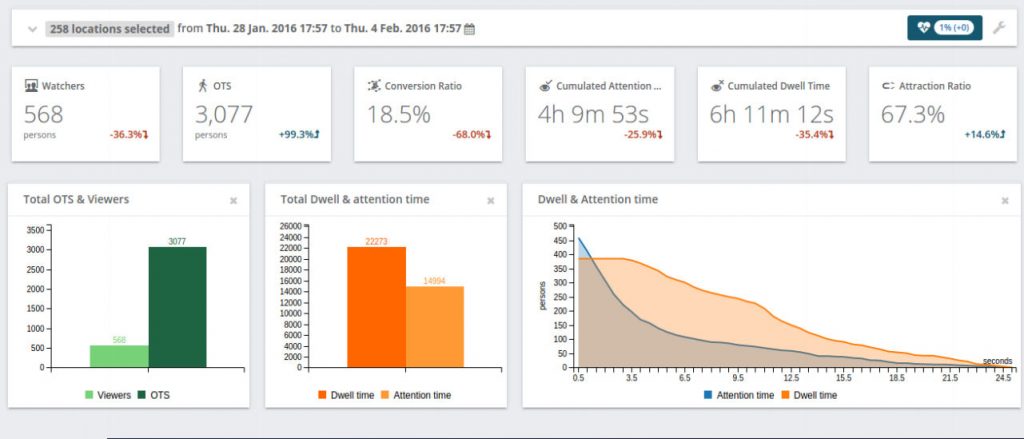
4.6 seconds : this is the average attention time that you could expect from viewers as they pass by screens. Quividi defines attention time as the duration during which a viewer had his faces turned towards the screen. This leaves little time no time to engage into long story telling, but more than enough to make an impact.

By construction, this value… is an average, as some screens can have an average attention as low as 1.5 sec, and others as high as 27 seconds.

This example is one of many that will be revealed in a benchmarking study that Quividi is preparing. Indeed, Quividi has been measuring over 150 screen networks since 2008 and 96 of them have accepted to contribute some anonymous data to a benchmark panel that we have created. This panel was built in such a way that no participating network would overwhelm others and each data point would be generated from a minimum of 8 screens coming from a minimum of 4 networks, thus ensuring both representativity and confidentiality, over 30M people from all around the world.

When it is published, the study will cover 18 typical situations, from a mix of 8 types of venues and 5 types of screen placements. The available data will consist of:

  • the number of average daily viewers,
  • average screen visibility ratio (ie percentages of by-passers taking a look to the screen)
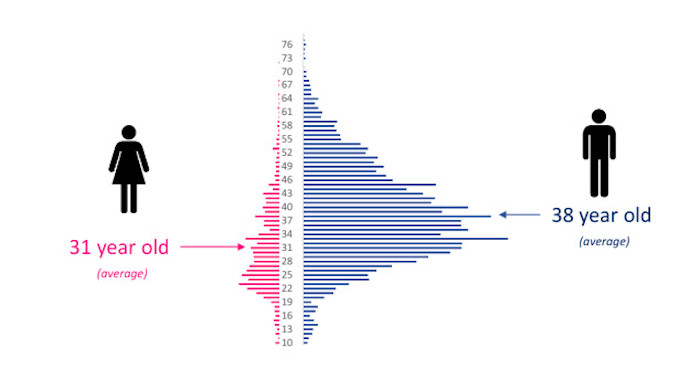
  • the average demographic breakdown (by gender & age group)
  • the average attention and dwell time

Stay tuned for more information.

Share this post: